Classic Solitaire: Regal Card
- 4.5
- Rating
- 1.00M
- Installs
- Free
- Price
 Analysis by App-foxy
I spent time with Classic Solitaire: Regal Card as a straightforward card game for short breaks, quiet evenings, and anyone who enjoys the familiar rhythm of arranging a deck. It comes from Ulpha Deep Labs, is free to download, and carries an Everyone age rating, so its appeal is easy to understand: there is no complicated premise to learn before starting. You open it, recognize the classic solitaire format, and can begin playing almost immediately.
That simplicity is both its strongest quality and the main thing you need to understand before installing it. This is not a story-driven game, a social card room, or a large collection of unrelated modes. It focuses on the classic solitaire experience and presents it as a light form of brain training. I found it most enjoyable when I treated each deal as a small concentration exercise rather than as a long-term progression game.
How the classic card format feels in everyday use
The game fits naturally into moments when I want something interactive but not demanding. A short wait, a coffee break, or the final few minutes before bed are better matches for it than a long gaming session. Solitaire has an unusual advantage over many mobile games: I can pause mentally at any point, return later, and continue without needing to remember a plot, a team setup, or a complicated control scheme.
You May Also Like

 Blood Strike: 2.5 Anniversary
Blood Strike’s Loadouts Turn Every Drop Into a Tactical Gamble
A close look at Blood Strike’s custom loadouts: how fast access to signature weapons reshapes its battle royale rhythm, rewards preparation, and narrows the gap between fights.

 Pandora - Music & Podcasts
Pandora’s Music Is Easy to Start, but Harder to Recover
Pandora’s strength is its low-effort path from a seed to a station. Its weak spot is how much confidence it asks you to place in connection, setup, and quiet recovery.

 8 Ball Pool
 Is Built on Rivalries, Rematches, and Routine
A close look at the rivalries, rematches, shared routines, and unanswered safety questions that turn a quick pool match into a persistent mobile community.

 Samsung Music
’s Quiet Strength Is Playing What You Already Own
Its reach comes less from spectacle than from dependable access to a personal library. That simplicity is both the app’s strongest retention engine and its ceiling.

 AccuWeather: Weather Radar
AccuWeather Review: A Quick, Clear Forecast for Everyday Decisions
For everyday plans, the best forecast is the one you can understand quickly. AccuWeather makes rain timing, radar, and local conditions easy to act on, with a few trade-offs.

 Hill Climb Racing
Why Hill Climb Racing Still Turns Crashes Into One More Run
A tiny car, a bumpy hill and one more upgrade: Hill Climb Racing keeps resurfacing because its simple chaos makes every near-miss feel personal.
More From Our News Desk



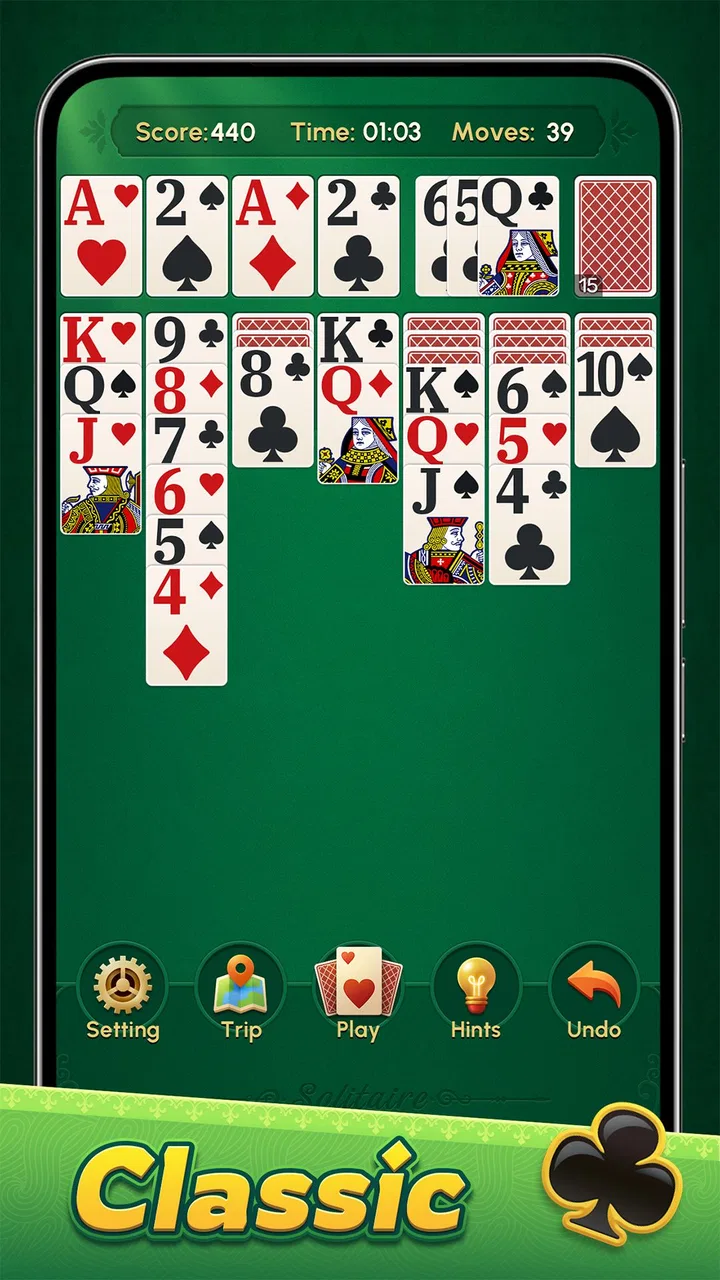
That makes this particular release approachable for people who already know the traditional rules and for newcomers who want a calm introduction to card logic. The basic decisions are familiar: reveal hidden cards, manage the open piles, and avoid using a card too early when it may be needed elsewhere. The challenge comes less from speed and more from noticing the consequences of each move.
I also like that the game does not ask the player to understand a large system before enjoying the first round. In a category crowded with card titles that add currencies, missions, tournaments, and elaborate reward tracks, a classic solitaire presentation can feel refreshingly direct. The trade-off is that players who need constant novelty may find the central activity repetitive.
The developer, Ulpha Deep Labs, released the game on September 20, 2024. It currently appears as version 1.12.0 and supports devices running Android 7.0 or later. Those details matter if you are using an older phone or tablet: the operating-system requirement is modest by current standards, but compatibility still depends on the device you plan to use.
Its reception is also substantial enough to suggest that the basic format has found an audience. The game has an average rating of 4.5 from around 26 thousand ratings, with roughly 2 thousand written reviews and more than a million installs. I would not treat those figures as a guarantee that every player will enjoy it, but they do show that this is not an obscure experiment with no established user base.
What I actually pay attention to during a deal
The most useful way to play is to slow down before making an apparently obvious move. When several cards are available, I first look for actions that reveal a hidden card or create a useful empty space. Moving a card simply because it can move is often less valuable than preserving flexibility for the next sequence.
That habit turns a familiar pastime into a small planning exercise. I try to avoid filling an open space too quickly, especially if doing so limits the cards that can be placed later. I also scan the tableau before touching the stock, because drawing immediately can hide the fact that a productive move is already available. These are simple techniques, but they make the game feel more thoughtful than a purely automatic card shuffle.
A second practical tip is to use short sessions as a focus reset instead of chasing a perfect run. If I approach every deal as a test I must win, the relaxed nature of solitaire disappears. If I use it for five or ten minutes of deliberate attention, the game works better as a mental break. That distinction is important for anyone attracted by the brain-training description but who does not want another stressful challenge on a phone.
Progress without turning every move into pressure
Classic solitaire naturally creates a mild sense of progress because each revealed card changes the available possibilities. Even without a story or character system, I can feel a round developing from a closed arrangement into a more manageable one. That gradual clarification is satisfying, especially when a blocked position opens after one carefully chosen move.
At the same time, the game’s appeal is not based on dramatic progression. You are returning to the card puzzle itself, not building a collection or unlocking a fictional world. For me, that is a benefit when I want a dependable routine. It is a limitation when I want a reason to keep playing beyond the next deal.
This is where spending and pressure become relevant. The game is free, but the information available to a prospective player does not establish a particular purchase structure, price, or paid advantage. I therefore would not assume that it is either completely free of monetization or heavily dependent on it. The sensible approach is to judge the actual in-game prompts on your own device and avoid treating the word “free” as a promise about every possible optional transaction.
From a fairness perspective, a solitaire game is naturally less dependent on other players than a competitive card title. There is no need to assemble a team, wait for opponents, or match your schedule with anyone else. That makes it easier to keep the experience personal and low pressure. It also means that any frustration usually comes from the deal or from my own decisions, rather than from another player exploiting a stronger account.
Where the challenge feels fair, and where expectations matter
Classic Solitaire works best when I accept that not every round is about speed. A quick move can feel efficient, but a slower inspection of the tableau often produces better choices. The fair part of the experience is that the rules are recognizable: success depends on card order, available options, and planning rather than on learning an elaborate set of special abilities.
Still, familiar rules do not automatically mean every deal will feel equally satisfying. Solitaire can produce positions that seem nearly solved and then become difficult because a needed card remains buried. If you prefer games where every loss is clearly caused by an opponent or where a precise skill test produces consistent results, this format may feel less transparent. The uncertainty of the deal is part of the traditional appeal, but it can also be the source of irritation.
I would especially avoid treating a losing round as proof that I played badly. Sometimes the better response is to review the sequence, notice whether I spent an important card too early, and then start again without overthinking it. That mindset keeps the game relaxing and prevents the familiar card layout from becoming a source of unnecessary pressure.
Compared with puzzle games built around timed levels, this solitaire title is calmer and less demanding on reflexes. Compared with online multiplayer card games, it is more private and easier to pick up briefly. Compared with large solitaire collections, its classic focus may feel cleaner, but players searching for several rule variations may prefer a broader alternative.
That comparison also clarifies who should skip it. I would not choose this game as a main option if I wanted competitive rankings, a strong narrative, frequent social interaction, or a deep progression system. I would also be cautious if repetitive card layouts quickly lose their charm. The game is a better fit for someone who values familiarity, quiet concentration, and sessions that can begin and end without ceremony.
Small habits that make the experience better
My first useful workflow is to separate discovery from cleanup. Early in a deal, I focus on revealing hidden cards and creating choices. Later, when the tableau is more open, I concentrate on organizing sequences and moving cards toward completion. Treating those stages differently prevents me from wasting an early opportunity just to make the board look tidy.
My second habit is to pause after every major reveal. A newly exposed card can change the best plan, and continuing automatically may cause me to miss a better route. This is particularly helpful on a phone, where a quick tap can become a chain of moves before I have considered the whole layout.
My third tip is to use the game as a controlled break rather than an endless distraction. I decide before starting whether I want one deal or a short period of play. That boundary is useful because solitaire’s “just one more round” quality is subtle: there may be no dramatic cliffhanger, but an unfinished arrangement can still tempt me to continue longer than planned.
For someone learning the rules, I would recommend watching the entire layout before making the first move. The important lesson is not merely where a card can go, but what that move prevents. New players often focus on immediate legal moves; experienced play is more about keeping future routes open. This game’s classic structure rewards that shift in attention.
Questions I would consider before installing
If you are wondering whether it is suitable for a quick daily routine, my answer is yes. The format does not require a long commitment, and the mental activity is easy to start and stop. It is particularly suitable for people who want a quiet alternative to scrolling through short videos or opening a more demanding game.
If you are asking whether it needs a modern phone, the listed minimum is Android 7.0 or later, which covers many older devices. I would still check the store compatibility notice for the specific handset, especially if you are installing on an aging tablet. The game is also labeled for Everyone, making it a broadly accessible choice from an age-rating standpoint.
If you want to know whether it is genuinely competitive, I would say no in the usual multiplayer sense. Its challenge is personal: I am competing with the puzzle, my previous decisions, and sometimes my patience. That can be more relaxing than a ranked card game, but it will not replace one if head-to-head competition is the reason you play.
If spending is your main concern, the download price is free. Beyond that, I would inspect any purchase prompts that appear during use rather than making assumptions. I appreciate that the game can be approached without an entry fee, but a careful player should still read each prompt and avoid buying anything impulsively, particularly when a difficult deal creates frustration.
Finally, if you are looking for variety, set your expectations correctly. The defining attraction is the classic solitaire format, not a large menu of unrelated card games. That focus is a strength for players who want one recognizable activity and a weakness for anyone who needs constant new mechanics.
My trust verdict after using it
I came away viewing this as a sensible, low-commitment card game rather than a title that tries to turn solitaire into something it is not. Ulpha Deep Labs keeps the identity centered on the traditional puzzle, and that makes the experience easy to understand. The free price and Everyone rating lower the barrier to trying it, while the familiar rules make the first session comfortable for a wide range of players.
The main limitation is equally clear: the game’s lasting value depends on whether you enjoy repeating the same kind of thoughtful card arrangement. I would not recommend it to someone who needs a campaign, social competition, or a constant stream of unlocks. I would recommend it to a friend who wants a dependable way to concentrate for a few minutes without learning a complicated new system.
My final advice is to approach it as a calm habit, not as a demanding test of intelligence. Take time to inspect the tableau, protect your future options, and stop when the session stops feeling refreshing. The best reason to install it is its uncomplicated, personal form of card play, not the promise of endless novelty or pressure to spend.
With its 4.5 average and broad install base, Classic Solitaire: Regal Card has clearly connected with many players. My own recommendation is qualified but positive: try it if classic solitaire is already your kind of game, especially for short offline-style moments of focus, while choosing a different card app if you want multiplayer rivalry, extensive variation, or a more visible progression system.
FAQs for Classic Solitaire: Regal Card
01What platforms is Classic Solitaire: Regal Card available on?
Classic Solitaire: Regal Card is available for download on both Android and iOS platforms. You can easily find it on the Google Play Store for Android devices and the Apple App Store for iOS devices. Ensure your device meets the minimum system requirements for a smooth gaming experience.
02Does Classic Solitaire: Regal Card require an internet connection to play?
No, Classic Solitaire: Regal Card can be played offline. It's designed to be accessible even when you don't have an internet connection, making it perfect for on-the-go gaming. However, certain features like leaderboards and updates may require internet access.
03Are there any in-app purchases in Classic Solitaire: Regal Card?
Yes, Classic Solitaire: Regal Card offers in-app purchases. While the game is free to download and play, there are optional purchases available to enhance your gaming experience, such as additional themes or power-ups. Be sure to manage your settings if you want to control in-app spending.
04What are the standout features of Classic Solitaire: Regal Card?
Classic Solitaire: Regal Card boasts elegant graphics and a user-friendly interface, making it easy for players of all ages to enjoy. Key features include multiple card themes, daily challenges, and customizable settings, allowing players to tailor their experience to their liking. It also offers a hint system to assist when you're stuck.
05How user-friendly is Classic Solitaire: Regal Card for beginners?
Classic Solitaire: Regal Card is highly user-friendly, even for beginners. The app includes a helpful tutorial that guides new players through the rules and mechanics of the game. Its intuitive design ensures that players can quickly understand how to navigate and enjoy the various features without prior experience.
Pros
- Smooth and intuitive card controls.
- Variety of themes and backgrounds.
- Daily challenges for extra rewards.
- Offline play without interruptions.
- Minimal ads enhance gameplay.
Cons
- Limited custom card designs.
- No multiplayer mode available.
- Occasional in-app purchase prompts.
- Lacks advanced statistical tracking.
- No landscape mode for tablets.

Classic Solitaire: Regal Card
Gallery